



-
15 min read
Jun 29, 2026 8:16:35 PM

Share On:


Independent contractor compliance services are managed programs that verify, classify, and continuously monitor your contractors so they are not legally treated as employees. Good providers combine worker classification, contract review, ongoing risk monitoring, and a fallback to Employer of Record coverage when a contractor does not qualify. The goal is simple. Keep flexible talent flexible without exposing the company to back taxes, penalties, and lawsuits.
For HR and People Ops leaders running a growing contractor base, this is no longer a quarterly legal chore. It is an operational system that has to run at the speed of hiring. This guide explains what these services actually cover, why the old audit model fails, and a faster model built around continuous verification.
Why Independent Contractor Compliance Became an Operational Problem
Independent contractor compliance is the discipline of proving, on an ongoing basis, that the people you pay as contractors are genuinely independent under the laws of every jurisdiction where they work. It matters more now because the contingent workforce is enormous and the rules shift constantly. When classification is wrong, the company, not the worker, absorbs the cost.
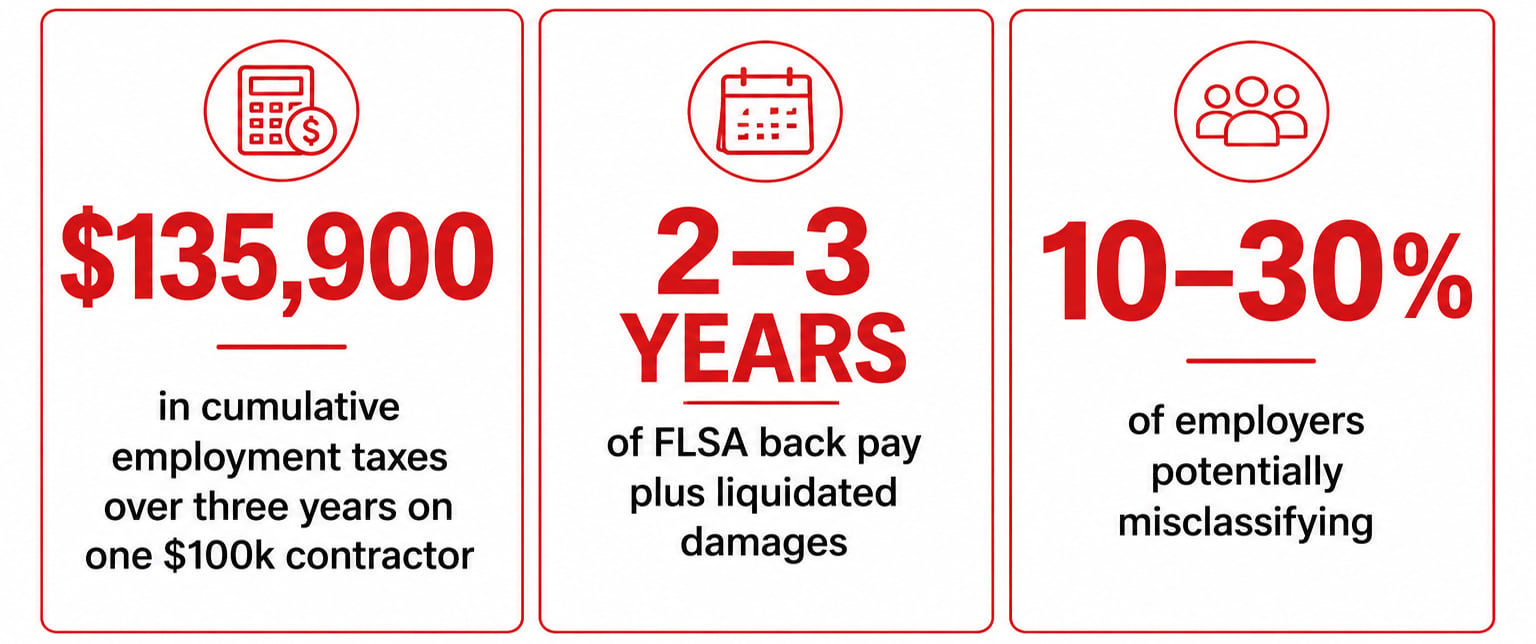
The scale is the first pressure. Staffing Industry Analysts valued the global contingent workforce market at roughly $10.2 trillion in 2024 across all contingent categories, with use projected to rise about 4% in 2027. In the United States alone, an estimated 72 million Americans were listed as independent workers in 2024, and research suggests as many as 10 to 30% of employers potentially misclassify workers.
The second pressure is enforcement that moves the liability up the chain to you. In the United Kingdom, changes to off-payroll working rules made midsize and large organizations liable for unpaid employment taxes where contractors working through their own limited company were incorrectly assessed as self-employed. Across the United States, the federal standard itself keeps moving. In May 2025, the Department of Labor announced it would not enforce the 2024 classification rule and would instead use its older Fact Sheet 13 economic realities approach, and state tests often differ from federal ones anyway.
The financial exposure is concrete. One worked example from advisory firm Plante Moran shows that for a contractor paid $100,000 a year who should have been an employee, cumulative employment tax liabilities of $135,900 over three years would be due, before interest and penalties. On top of that, the Fair Labor Standards Act lets a misclassified worker recover back overtime for two years, or three years if the misclassification is willful, plus liquidated damages and attorneys fees.
Takeaway: the question is no longer whether to manage contractor compliance. It is whether your current method can keep pace with how fast your managers hire.
What Independent Contractor Compliance Services Actually Include
A complete independent contractor compliance service covers four jobs. It verifies that a worker qualifies as a contractor, structures a compliant agreement, monitors the relationship over time, and provides a compliant employment path when the contractor does not qualify. Weaker offerings stop at a one time classification check. The relationship is what creates risk, so the monitoring is the part that protects you.
Here is what to expect from a serious IC compliance solution.
1. Classification and IC verification services. A documented determination of whether each worker is genuinely independent, tested against the relevant jurisdiction. This is the foundation, and it has to be repeatable, not a one off opinion.
2. Contract and documentation review. Statements of work, business registration, insurance, and the contract terms that evidence independence rather than control.
3. Ongoing monitoring. Tracking how the engagement actually behaves over time, since a contractor who slowly starts working like an employee is the most common way clean engagements turn into liabilities.
4. EOR and AOR fallback. When a worker does not pass, the provider can engage them compliantly through Employer of Record or Agent of Record coverage so the work continues without the risk.
A practical example. A SaaS company engages a designer in Spain as a contractor. A real compliance service checks the Spanish standard, finds the designer works full time under direct supervision using company tools, flags the engagement, and routes the person to EOR employment before a labor authority ever asks the question. That is the difference between a service and a checkbox.
Takeaway: if a provider only sells a classification report, you are buying a snapshot of a moving target.
The Contrarian Take Compliance Is an Engineering Problem Not a Legal Audit
The most expensive mistake in this field is treating compliance as a static, backward looking legal audit. An audit tells you what was true last quarter. By the time the report lands, managers have already hired more people, and the engagements have already drifted. That lag is the risk. The fix is to treat independent contractor compliance solutions as an engineering problem and build the guardrails directly into how people get onboarded.
This reframing matters because the real failure mode is rarely a single bad classification call. It is loss of visibility at scale. As one global workforce advisory notes, contractor hiring in multinational businesses is often decentralized, with regional teams and project leaders engaging workers independently of central HR, leaving no single source of truth and letting non compliant arrangements become embedded in daily operations. You cannot audit your way out of a visibility problem. You have to design it out.
Engineering language is the right frame here. In software, teams shift testing left, meaning they catch defects at the moment code is written rather than after release, because late detection is exponentially more expensive. Compliance works the same way. Catch the classification issue at onboarding, automatically, and it costs a form field. Catch it in a labor audit two years later, and it costs back taxes, penalties, and a lawsuit.
Takeaway: a backward looking audit measures yesterday. A forward looking system governs today, which is the only point in time you can still change the outcome.
The Dynamic Risk Tiering Model A Faster Way to Stay Compliant
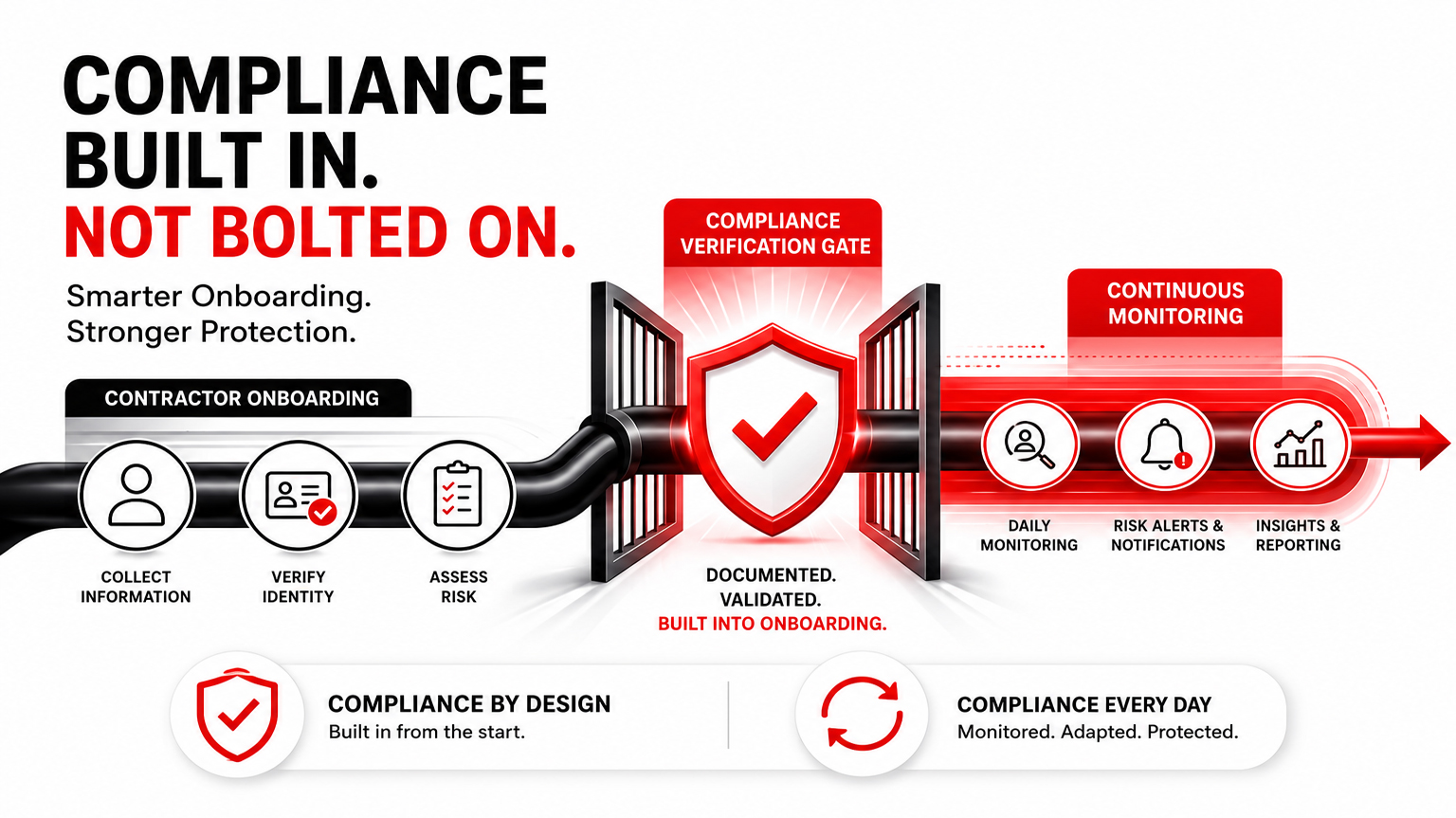
Dynamic Risk Tiering is N2S Global's model for shifting compliance left by building a two tier digital guardrail directly into contractor onboarding. Tier 1 uses automated data gates to instantly validate a worker's independent business infrastructure, or auto routes them to Employer of Record coverage when they do not qualify. Tier 2 then monitors the behavioral realities of the engagement, such as tools used and degree of control, in real time. The model replaces a slow legal review with a fast, continuous system.
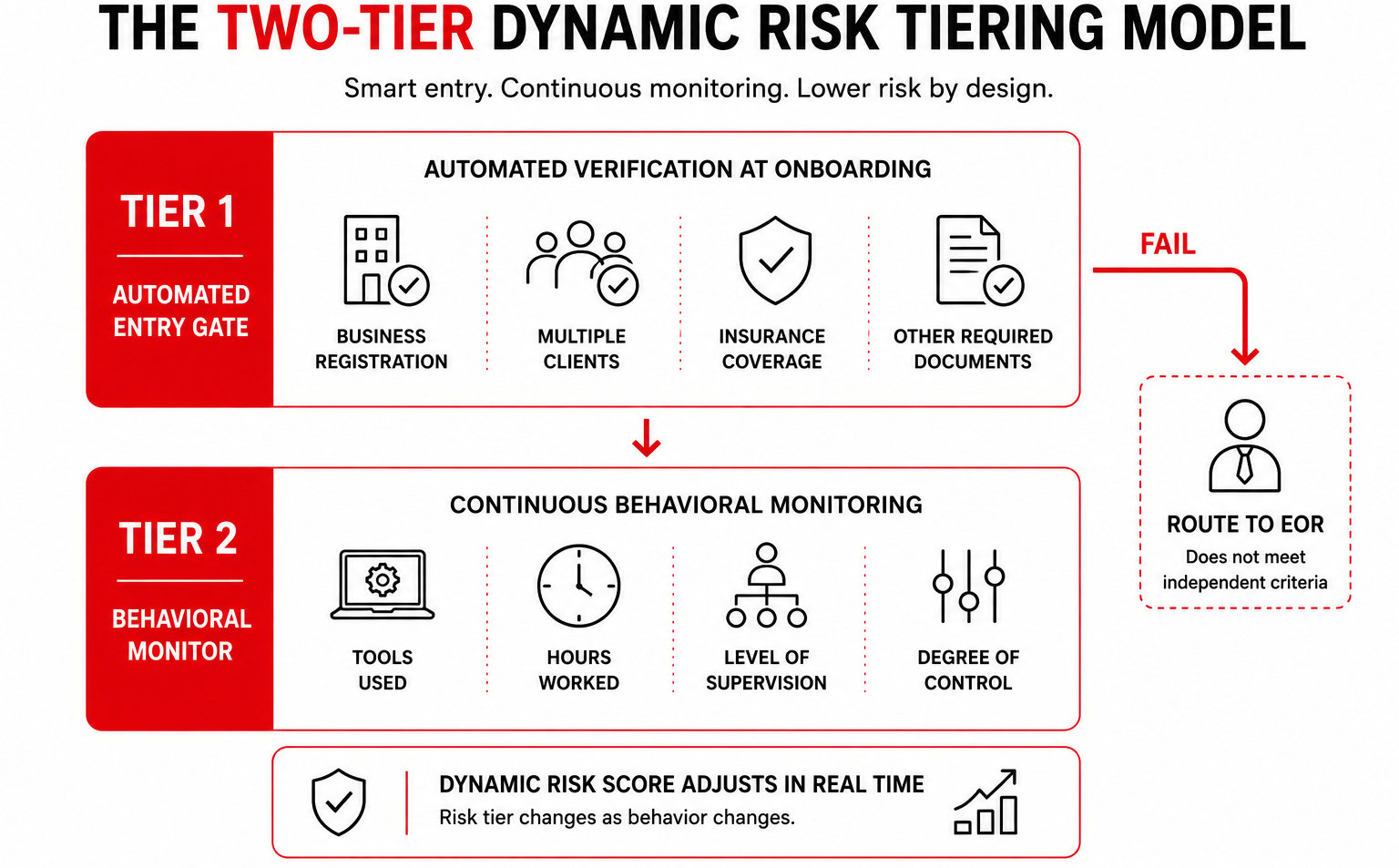
Tier 1 the automated entry gate. At onboarding, the system checks the objective markers of genuine independence, things like business registration, multiple clients, independent tooling, and insurance. A worker who clears Tier 1 proceeds as a contractor. A worker who fails is automatically routed to EOR employment instead of being quietly onboarded as a contractor by an impatient manager. The decision happens at the gate, not in a later audit.
Tier 2 the behavioral monitor. Classification is not a one time event, because control is what regulators actually test, and control reveals itself over time. Tier 2 watches the live signals of the relationship. Is the contractor now using only company systems? Are they working fixed hours under direct supervision? Those behavioral shifts are the early warning that an independent contract services arrangement is sliding toward employment, and they get flagged before they become evidence.
The 14 Day Velocity Rule
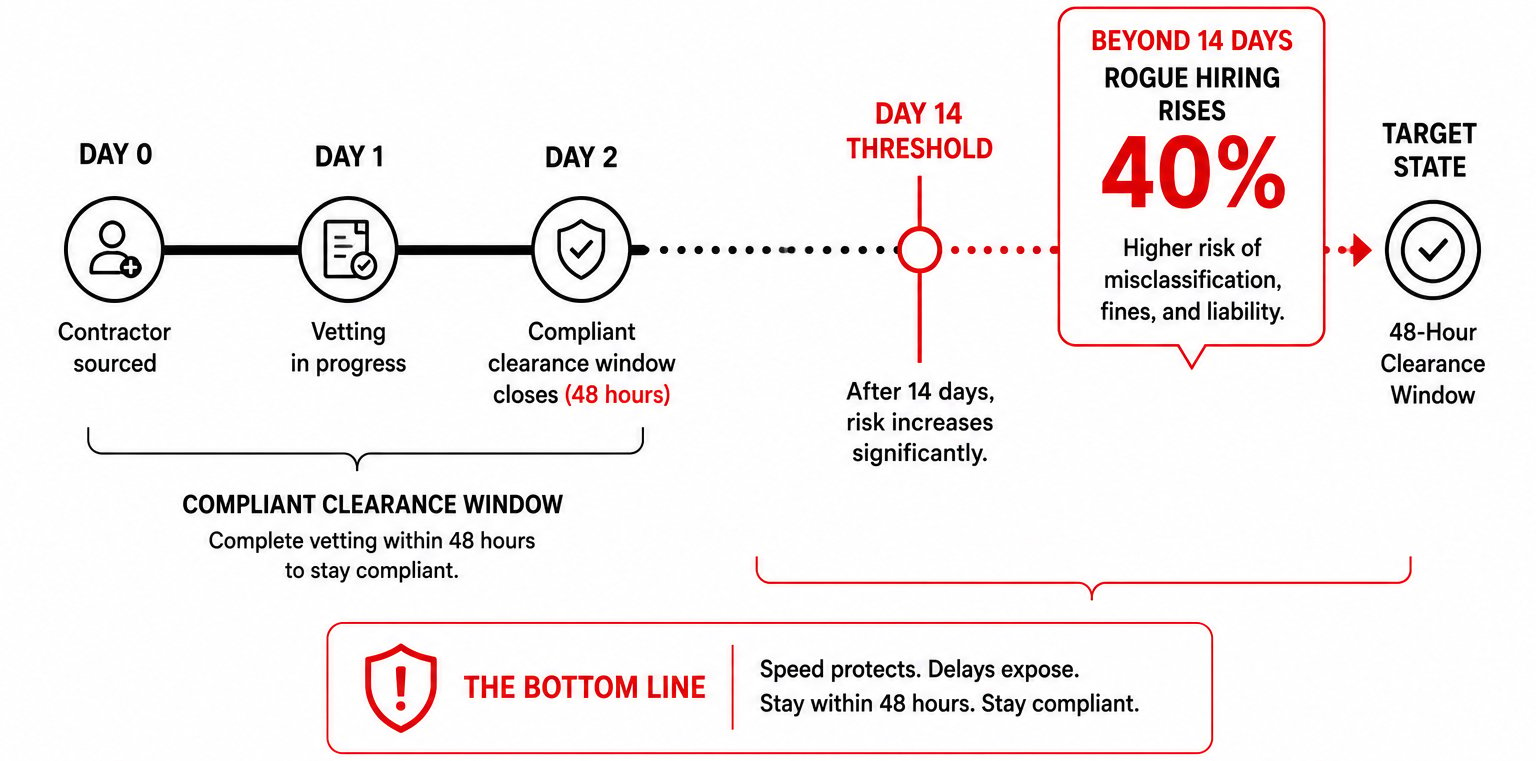
This is the heart of the model, and it is where speed becomes a compliance feature rather than a tradeoff. N2S Global's 14 Day Velocity Rule states that when manual legal vetting pushes contractor onboarding past 14 days, rogue hiring by impatient managers rises by 40%, which blinds the enterprise to its true misclassification exposure. The countermeasure is a target of compliant, automated clearance within a 48 hour window.
The logic is straightforward and matches what the research says about decentralized hiring. Slow central compliance does not stop hiring. It pushes hiring into the shadows, where regional managers engage contractors directly with no classification check at all. Every day past the two week mark, more of your workforce becomes invisible to compliance. Velocity is therefore not a convenience. It is the mechanism that keeps engagements inside the system where they can be governed.
Takeaway: if compliant onboarding is slower than rogue onboarding, your managers will choose rogue every time, and your risk goes dark.
EOR AOR and PEO How the Pieces Fit Together
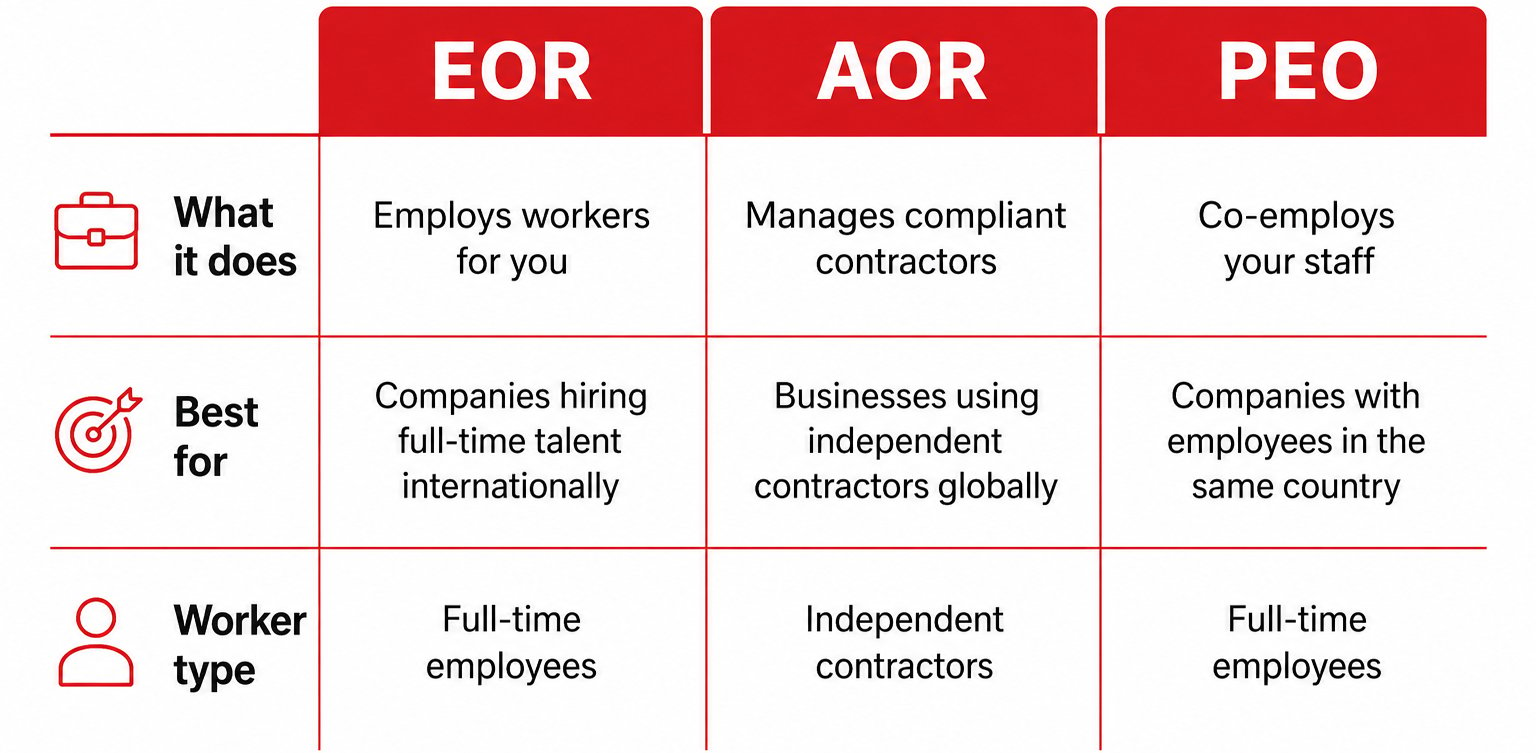
Employer of Record, Agent of Record, and Professional Employer Organization are three different ways to engage and compliantly manage workers, and they solve different problems. EOR legally employs a worker on your behalf in a country where you have no entity. AOR engages and manages independent contractors compliantly, which is the IC compliance layer. PEO co employs your existing employees to handle payroll, benefits, and HR compliance. Most enterprises need a mix.
The table below summarizes when each model fits.
|
Model |
What it does |
Best for |
Worker type |
|---|---|---|---|
|
EOR |
Legally employs the worker for you, no local entity needed |
Hiring full employees in new countries fast |
Employees |
|
AOR |
Engages and manages contractors with compliant classification |
Scaling a compliant contractor base |
Independent contractors |
|
PEO |
Co employs your staff to run payroll, benefits, and HR |
Streamlining HR for your own employees |
Your employees |
In the Dynamic Risk Tiering model these are not separate products. AOR runs your contractor compliance, and EOR is the automatic fallback the moment a worker fails Tier 1. That integration is what lets onboarding stay fast without staying risky.
Takeaway: the strongest IC compliance solutions do not just classify. They have an EOR escape hatch wired in, so a failed check becomes a compliant hire instead of a blocked one.
Key Takeaways
Independent contractor compliance services verify, classify, and continuously monitor contractors, with EOR coverage as a fallback when a worker does not qualify.
Misclassification exposure is large and personal to your company, including six figure tax liabilities and multi year back pay under laws like the FLSA.
The static legal audit model fails because it measures the past while your workforce drifts in the present.
The Dynamic Risk Tiering model shifts compliance left with an automated Tier 1 entry gate and Tier 2 behavioral monitoring.
The 14 Day Velocity Rule captures the core tradeoff. Slow vetting drives a 40% rise in rogue hiring, so compliant clearance should target a 48 hour window.
Frequently Asked Questions
What are independent contractor compliance services? They are managed programs that confirm your contractors are genuinely independent under local law, then keep them compliant over time. A full service includes IC verification services, contract review, ongoing behavioral monitoring, and an Employer of Record fallback for workers who do not qualify. The aim is to protect the company from misclassification penalties while keeping access to flexible talent.
How much does contractor misclassification actually cost? The cost is far higher than the savings. One advisory example shows around $135,900 in cumulative employment taxes over three years for a single $100,000 contractor who should have been an employee, before interest and penalties. Under the FLSA, a worker can also recover back overtime for two to three years plus liquidated damages and attorneys fees.
What is the difference between IC compliance services and an EOR? IC compliance services, often delivered as Agent of Record, keep genuine contractors compliant. An Employer of Record legally employs a worker for you in a country where you have no entity. They work together. When a worker fails an IC verification check, the smart move is to engage them through EOR rather than risk treating an employee as a contractor.
Why is fast onboarding part of compliance? Because slow vetting does not stop hiring, it hides it. When central review drags past two weeks, managers engage contractors directly with no classification check, and that population becomes invisible to compliance. N2S Global's 14 Day Velocity Rule ties this together, noting a 40% rise in rogue hiring past 14 days, so compliant onboarding should target a 48 hour window.
Do classification rules really change that often? Yes. The United States federal standard shifted again in May 2025 when the Department of Labor stopped enforcing the 2024 rule and reverted to an older economic realities approach, and state tests frequently differ from federal ones. Other countries tighten enforcement too, including UK off payroll rules that push tax liability onto the engaging organization. Ongoing monitoring is the only reliable response.
Can compliance solutions scale across multiple countries? Yes, and multi country scale is exactly where they earn their keep. Classification criteria vary by jurisdiction, and decentralized hiring across regions creates blind spots. A single compliance solution that applies consistent verification and monitoring across every country, with EOR coverage built in, gives you one source of truth instead of dozens of unmanaged local arrangements.
Conclusion
Independent contractor compliance is not a legal formality you handle once a year. It is a live system that has to run as fast as your managers hire. The companies that get burned are not the ones with the wrong intentions. They are the ones whose compliance process was too slow and too backward looking to keep up with their own growth. Treat it as an engineering problem, build the guardrails into onboarding, and speed becomes your protection rather than your weakness.
If you are scaling a contractor workforce across borders and want compliance that runs at the speed of hiring, talk to N2S Global about implementing Dynamic Risk Tiering for your team. Book a compliance consultation to map your current exposure and design a 48 hour compliant onboarding flow.
Sonya Kapoor is a content writer who work with N2S's Texas office. During the day, she is an author, and in the evening, she is an avid reader. She shies away from conversing about herself in the third individual, but can be cajoled to do so sometimes.
Subscribe to
our Newsletter
We are ready to help you until and unless you find the right ladder to success.
-1.jpg)




Comments